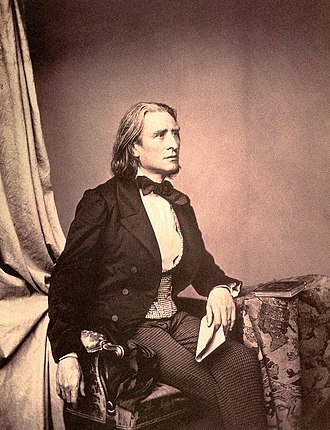
Ludwig Van Beethoven
Ludwig van Beethoven[n 1] (baptised 17 December 1770 – 26
March 1827) was a German composer and pianist. Beethoven remains
one of the most admired composers in the history of Western music;
his works rank among the most performed of the classical music repertoire
and span the transition from the Classical period to the Romantic era
in classical music. His career has conventionally been divided into
early, middle, and late periods. His early period, during which he
forged his craft, is typically considered to have lasted until 1802.
From 1802 to around 1812, his middle period showed an individual
development from the styles of Joseph Haydn and Wolfgang Amadeus
Mozart, and is sometimes characterized as heroic. During this time,
he began to grow increasingly deaf. In his late period, from 1812
to 1827, he extended his innovations in musical form and expression.
Beethoven was born in Bonn. His musical talent was obvious at an
early age. He was initially harshly and intensively taught by his
father, Johann van Beethoven. Beethoven was later taught by the
composer and conductor Christian Gottlob Neefe, under whose tutelage
he published his first work, a set of keyboard variations, in 1783.
He found relief from a dysfunctional home life with the family of Helene
von Breuning, whose children he loved, befriended, and taught piano.
At age 21, he moved to Vienna, which subsequently became his base, and
studied composition with Haydn. Beethoven then gained a reputation as a
virtuoso pianist, and was soon patronised by Karl Alois,
Prince Lichnowsky for compositions, which resulted in his three
Opus 1 piano trios (the earliest works to which he accorded an opus
number) in 1795.
His first major orchestral work, the First Symphony, premiered in
1800, and his first set of string quartets was published in 1801.
Despite his hearing deteriorating during this period, he continued
to conduct, premiering his Third and Fifth Symphonies in 1804 and
1808, respectively. His Violin Concerto appeared in 1806. His last
piano concerto (No. 5, Op. 73, known as the Emperor), dedicated to
his frequent patron Archduke Rudolf of Austria, premiered in 1811,
without Beethoven as soloist. He was almost completely deaf by 1814,
and he then gave up performing and appearing in public. He described his
problems with health and his unfulfilled personal life in two letters,
his Heiligenstadt Testament (1802) to his brothers and his unsent love
letter to an unknown "Immortal Beloved" (1812).
After 1810, increasingly less socially involved, Beethoven composed
many of his most admired works, including later symphonies, mature
chamber music and the late piano sonatas. His only opera, Fidelio,
first performed in 1805, was revised to its final version in 1814.
He composed Missa solemnis between 1819 and 1823 and his final
Symphony, No. 9, one of the first examples of a choral symphony,
between 1822 and 1824. Written in his last years, his late string
quartets, including the Grosse Fuge, of 1825–1826 are among his final
achievements. After several months of illness, which left him bedridden,
he died in 1827.
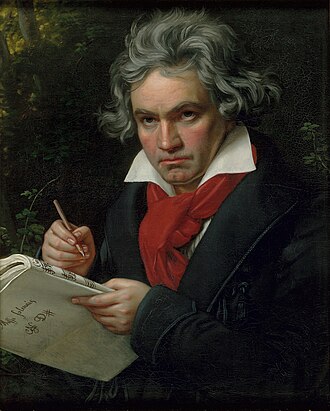
Franz Liszt
Franz Liszt[n 1] (22 October 1811 – 31 July 1886) was a
Hungarian composer, virtuoso pianist, conductor, and teacher
of the Romantic period. With a diverse body of work spanning
more than six decades, he is considered to be one of the most
prolific and influential composers of his era and remains one
of the most popular composers in modern concert piano repertoire.[1]
Liszt first gained renown during the early nineteenth century for his
virtuoso skill as a pianist.[2] Regarded as one of the greatest pianists
of all time, he toured Europe during the 1830s and 1840s, often playing for
charity.[3] In these years, Liszt developed a reputation for his powerful
performances as well as his physical attractiveness.[4] In what has now been
dubbed "Lisztomania", he rose to a degree of stardom and popularity among the
public not experienced by the virtuosos who preceded him — whereas earlier
performers mostly served the upper class, Liszt attracted a more general audience
.[5][6] During this period and into his later life, Liszt was a friend, musical
promoter and benefactor to many composers of his time, including Frédéric Chopin,
Charles-Valentin Alkan, César Franck, Richard Wagner, Hector Berlioz, Robert
Schumann, Clara Schumann, Camille Saint-Saëns, Edvard Grieg, Ole Bull, Joachim Raff,
Mikhail Glinka, and Alexander Borodin.[7]