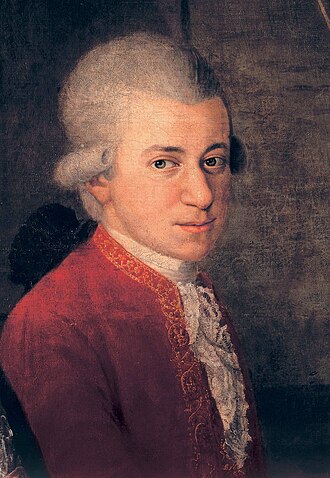
Wolfgang Amadeus Mozart
Wolfgang Amadeus Mozart[a][b] (27 January 1756 – 5 December 1791)
was a prolific and influential composer of the Classical period.
Despite his short life, his rapid pace of composition resulted in
more than 800 works of virtually every genre of his time. Many of
these compositions are acknowledged as pinnacles of the symphonic
concertante, chamber, operatic, and choral repertoire. Mozart is
widely regarded as among the greatest composers in the history of
Western music,[1] with his music admired for its "melodic beauty,
its formal elegance and its richness of harmony and texture".[2]
Born in Salzburg, then in the Holy Roman Empire and currently in
Austria, Mozart showed prodigious ability from his earliest childhood.
Already competent on keyboard and violin, he composed from the age of
five and performed before European royalty. His father took him on a
grand tour of Europe and then three trips to Italy. At 17, he was a
musician at the Salzburg court but grew restless and travelled in search
of a better position.
While visiting Vienna in 1781, Mozart was dismissed from his
Salzburg position. He stayed in Vienna, where he achieved fame but
little financial security. During his final years there, he composed
many of his best-known symphonies, concertos, and operas. His Requiem
was largely unfinished by the time of his death at the age of 35, the
circumstances of which are uncertain and much mythologised.