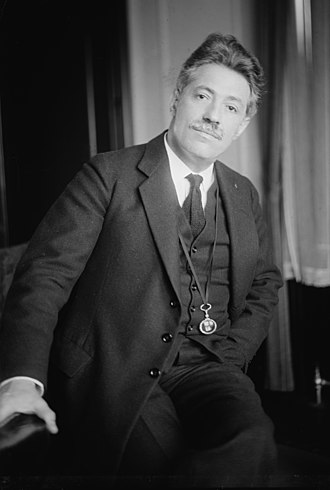
Sergei Rachmaninoff
Sergei Vasilyevich Rachmaninoff[a][b] (1 April [O.S. 20 March]
1873 – 28 March 1943) was a Russian composer, virtuoso pianist, and
conductor. Rachmaninoff is widely considered one of the finest pianists
of his day and, as a composer, one of the last great representatives of
Romanticism in Russian classical music. Early influences of Tchaikovsky,
Rimsky-Korsakov, and other Russian composers gave way to a thoroughly personal
idiom notable for its song-like melodicism, expressiveness, dense contrapuntal
textures, and rich orchestral colours.[4] The piano is featured prominently in
Rachmaninoff's compositional output and he used his skills as a performer to
fully explore the expressive and technical possibilities of the instrument.
Born into a musical family, Rachmaninoff began learning the piano at the age of
four. He studied piano and composition at the Moscow Conservatory, from which he
graduated in 1892, having already written several compositions. In 1897, following
the disastrous premiere of his Symphony No. 1, Rachmaninoff entered a four-year
depression and composed little, until supportive therapy allowed him to complete
his well-received Piano Concerto No. 2 in 1901. Rachmaninoff went on to become
conductor of the Bolshoi Theatre from 1904–06, and relocated to Dresden, Germany,
in 1906. He later embarked upon his first tour of the United States as a pianist
in 1909.
After the Russian Revolution, Rachmaninoff and his family left Russia permanently,
settling in New York in 1918. Following this, he spent most of his time touring as a
pianist through the US and Europe, from 1932 onwards spending his summers at his
villa in Switzerland. During this time, Rachmaninoff's primary occupation was
performing, and his compositional output decreased significantly, completing just
six works after leaving Russia. By 1942, his declining health led him to move to
Beverly Hills, California, where he died from melanoma in 1943.
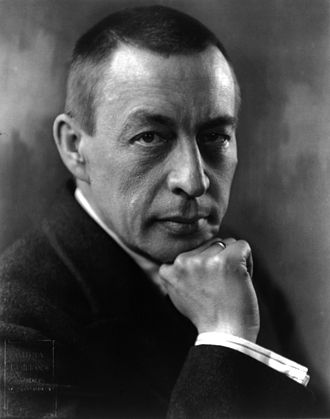
Boulanger
Marie-Juliette Olga "Lili" Boulanger (French:
[maʁi ʒyljɛt lili bulɑ̃ʒe] ⓘ; 21 August 1893 – 15 March 1918)
was a French composer and the first female winner of the Prix
de Rome composition prize.[1] Her older sister was the noted
composer and composition teacher Nadia Boulanger.As a child
born in Paris, Boulanger's talent was apparent at a very young
age; at the age of two, she was already singing melodies by ear.
[2] Her parents, both of whom were musicians, encouraged their
daughter's musical education. Her mother, Raissa Myshetskaya
(Mischetzky), was a Russian princess who married her Paris Conservatoire
teacher, Ernest Boulanger (1815–1900), who won the Prix de Rome in 1835.
Her father was 77 years old when she was born and she became very attached
to him. Her grandfather Frédéric Boulanger had been a noted cellist and her
grandmother Juliette a singer.
Boulanger accompanied her ten-year-old sister Nadia to classes at the Paris
Conservatoire before she was five, shortly thereafter sitting in on classes
on music theory and studying organ with Louis Vierne. She also sang and played
piano, violin, cello and harp. Her teachers included Marcel Tournier and
Alphonse Hasselmans for harp, Mme Hélène Chaumont for piano and Fernand Luquin
for violin.
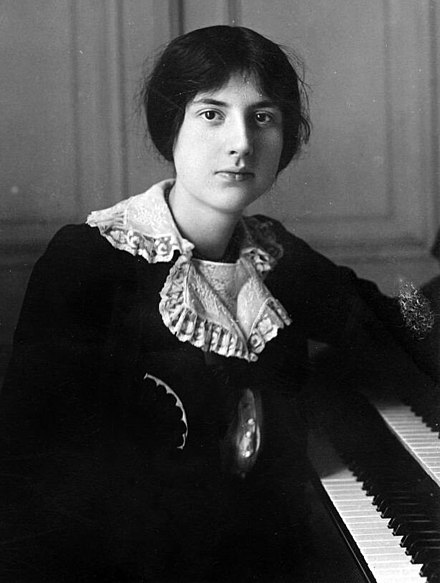
Fritz Kreisler
Friedrich "Fritz" Kreisler (February 2, 1875 – January 29, 1962)
was an Austrian-born American violinist and composer.[1] One of the
most noted violin masters of his day, and regarded as one of the greatest
violinists of all time, he was known for his sweet tone and expressive
phrasing. Like many great violinists of his generation, he produced a
characteristic sound which was immediately recognizable as his own.
Although it derived in many respects from the Franco-Belgian school,
his style is nonetheless reminiscent of the gemütlich (cozy) lifestyle
of pre-war Vienna.Kreisler wrote a number of pieces for the violin, including
solos for encores, such as "Liebesleid" and "Liebesfreud". Some of Kreisler's
compositions were pastiches ostensibly in the style of other composers. They
were originally ascribed to earlier composers, such as Gaetano Pugnani, Giuseppe
Tartini and Antonio Vivaldi, and then, in 1935, Kreisler revealed that it was
he who wrote the pieces. When critics complained, Kreisler replied that they
had already deemed the compositions worthy: "The name changes, the value
remains", he said. He also wrote operettas, including Apple Blossoms in 1919[8]
and Sissy [de] in 1932, a string quartet, and cadenzas, including ones for
Brahms's Violin Concerto, Paganini's D major Violin Concerto, and Beethoven's
Violin Concerto. His cadenzas for the Beethoven concerto are the ones most
often played by violinists today.
He wrote the music for the 1936 movie The King Steps Out directed by Josef von
Sternberg, based on the early years of Empress Elisabeth of Austria.
Kreisler performed and recorded his own version of the first movement of Paganini's D
major Violin Concerto. The movement is rescored and in some places reharmonised,
and the orchestral introduction is completely rewritten in some places. The overall
effect is of a late-nineteenth-century work.